
Equity Multiple in Affordable & Workforce Housing
Key Takeaways
Equity multiple equals total cash distributions (including sale proceeds) divided by total equity invested—a 2.0x multiple means receiving $2 back for every $1 invested.
This metric is simple and intuitive but ignores the time value of money and risk, so it must be paired with internal rate of return and cash on cash return for proper evaluation.
In affordable and workforce housing backed by programs like LIHTC and Section 8, equity multiple helps investors see total cash returned over 10–15+ year holding periods.
Granite Park Capital uses equity multiple at both deal and fund level to evaluate and communicate performance to accredited investors and family offices.
A good equity multiple depends on strategy, leverage, and hold duration—stabilized affordable housing typically targets 1.7x–2.2x over extended horizons.
What Is Equity Multiple in Real Estate?
For real estate investors evaluating commercial real estate investment opportunities, equity multiple stands as one of the most straightforward metrics for understanding total return potential. It answers a fundamental question: for every dollar invested, how many dollars will come back?
Equity multiple describes the ratio of total cash distributions received from an investment divided by the total equity invested. Those distributions include net operating cash flow during the holding period, any proceeds from refinancing, and net sale proceeds when the property is sold or recapitalized. The formula captures the entire life cycle of an investment from initial capital contribution through final exit.
An equity multiple greater than 1.0x indicates that investors receive more cash back than they contributed—a profitable outcome. A 2.0x multiple means doubling the original investment. Conversely, a lower equity multiple below 1.0x signals a loss of invested capital, meaning investors received less cash than they put in.
This metric is widely used across private real estate, including multifamily, industrial, and office properties. It holds particular relevance in longer-duration programs common to affordable and workforce housing, such as LIHTC (Low Income Housing Tax Credit) and HUD-backed developments where investment holding period often extends to 10–15 years.
Unlike internal rate of return or percentage rate metrics, equity multiple measures the investment’s absolute return potential rather than annualized performance. It tells investors the magnitude of returns without factoring in how quickly those returns materialize.
Equity Multiple Formula and Step-by-Step Calculation
The equity multiple calculation is remarkably straightforward—simple enough to work through on a notepad or in a basic spreadsheet.
The formula:
Equity Multiple = Total Cash Distributions ÷ Total Equity Invested
The numerator includes all cash that flows back to investors:
Operating distributions throughout the entire holding period
Net sale proceeds after debt repayment and closing costs
Any refinancing proceeds distributed to equity holders
The denominator represents total equity investment:
Initial investment amount at closing
Subsequent capital calls during the hold
Major capital expenditures funded directly by investors
Total cash distributions should be measured before investor-level taxes but after property-level expenses, interest payments, and loan amortization. This gives investors a clear view of actual cash returns received.
Quick Example:
An investor contributes $200,000 to a workforce housing acquisition. Over seven years, they receive $84,000 in cumulative operating distributions. At sale, they receive $280,000 in net proceeds after the loan payoff.
Total distributions: $84,000 + $280,000 = $364,000
Equity Multiple: $364,000 ÷ $200,000 = 1.82x
For every dollar invested, this investor receives $1.82 back—earning compared to their initial stake plus an 82% profit over the hold.
Equity Multiple Calculation Example in Affordable Housing
Let’s walk through a realistic 10-year LIHTC-style investment to illustrate how equity multiple works in practice for affordable and workforce housing.
The Investment Setup:
In January 2025, a group of accredited investors contributes $5,000,000 of total equity to acquire and rehabilitate a 200-unit Section 8 supported property through an investment fund. The property generates stable rental income backed by government rent subsidies.
Annual Cash Distributions:

Total operating distributions over 10 years: $4,400,000
Exit Event:
In Year 10, the property is sold. After repaying the remaining debt balance and covering closing costs, net sale proceeds to equity investors total $7,000,000.
Calculating the Equity Multiple:
Total Cash Distributions = $4,400,000 + $7,000,000 = $11,400,000
Equity Multiple = $11,400,000 ÷ $5,000,000 = 2.28x
What This Means for Investors:
A 2.28x equity multiple means investors receive $2.28 for every $1 they contributed
The total profit equals $6,400,000 on a $5,000,000 investment
This outcome reflects both consistent annual income from government-backed rents and meaningful appreciation at exit
For an accredited investor allocating to a Granite Park Capital fund, this example illustrates how affordable housing investments can deliver attractive equity multiples through a combination of steady cash flows and disciplined asset management over extended holding periods.

Equity Multiple vs. IRR (Internal Rate of Return)
Both equity multiple and internal rate of return are standard metrics in private equity real estate. Institutional investors and family offices almost always evaluate these two figures together because each reveals something different about an investment opportunity.
Internal rate of return is the annualized percentage rate that discounts all projected cash flows—both inflows and outflows—to a net present value of zero. It accounts for when cash is received, not just how much.
The critical distinction: equity multiple ignores the timing of cash flows, while IRR is extremely sensitive to it. An investment that returns cash early will have a higher IRR than one that delivers most proceeds at sale, even if both have identical total cash returns.
Comparison Example:

Both investments deliver the same 2.0x equity multiple, but the first investment has a dramatically higher IRR because investors faster receive their returns. The second investment ties up capital much longer before delivering the same total profit.
This distinction matters enormously in long-duration affordable housing funds. A 10–15 year LIHTC project may generate modest annual distributions but deliver substantial value at exit through a recapitalization or sale. The equity multiple captures total wealth creation while a lower IRR reflects the extended time horizon.
Granite Park Capital underwrites and reports both IRR and equity multiple to give investors a complete picture of both the pace and magnitude of returns. Focusing on just one metric provides an incomplete view of the investment’s potential risks and rewards.
Equity Multiple vs. Cash-on-Cash Return
Equity multiple and cash on cash return both relate cash flow to invested equity, but they operate on fundamentally different time scales.
Cash on cash return equals annual pre-tax cash flow divided by current invested equity, expressed as a percentage for each year. It measures ongoing income yield—what you earn compared to your capital on an annual basis.
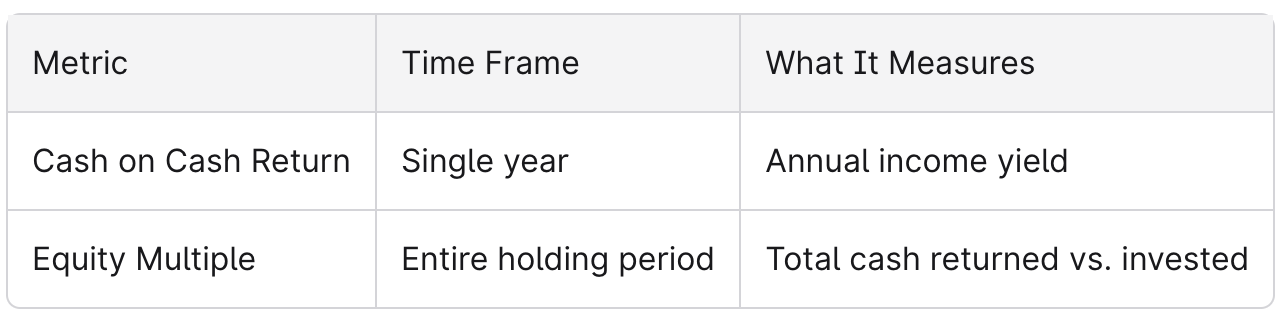
Cash on cash focuses on steady income (for example, 7–9% per year in stabilized affordable housing), while equity multiple captures everything including the exit event that often represents the largest portion of total distributions.
Illustration:
A workforce housing property generates an 8% average annual cash on cash return over 12 years. At sale, investors also receive substantial proceeds from property appreciation.
Annual income: $80,000 per year on $1,000,000 invested
12-year operating distributions: $960,000
Net sale proceeds: $1,340,000
Total distributions: $2,300,000
Equity Multiple: 2.3x
The 8% cash on cash demonstrates reliable annual income, while the 2.3x equity multiple reflects total wealth creation including the profitable exit.
In government-supported housing under Section 8, HUD, or LIHTC programs, relatively stable rents may create consistent cash returns year after year. However, the property’s equity multiple is heavily influenced by the final recapitalization or sale—the culmination of years of value preservation and operational improvements.
For investors weighing potential investments, cash on cash gauges income profile while equity multiple assesses total profit over the fund life. Both matter, and both deserve attention.
What Is a Good Equity Multiple in Private Real Estate?
There is no universal answer to what constitutes a good equity multiple. A good equity multiple depends on strategy, leverage, hold duration, and risk profile. An excellent multiple for a core stabilized asset might be mediocre for a ground-up development.
Typical Target Ranges by Strategy:
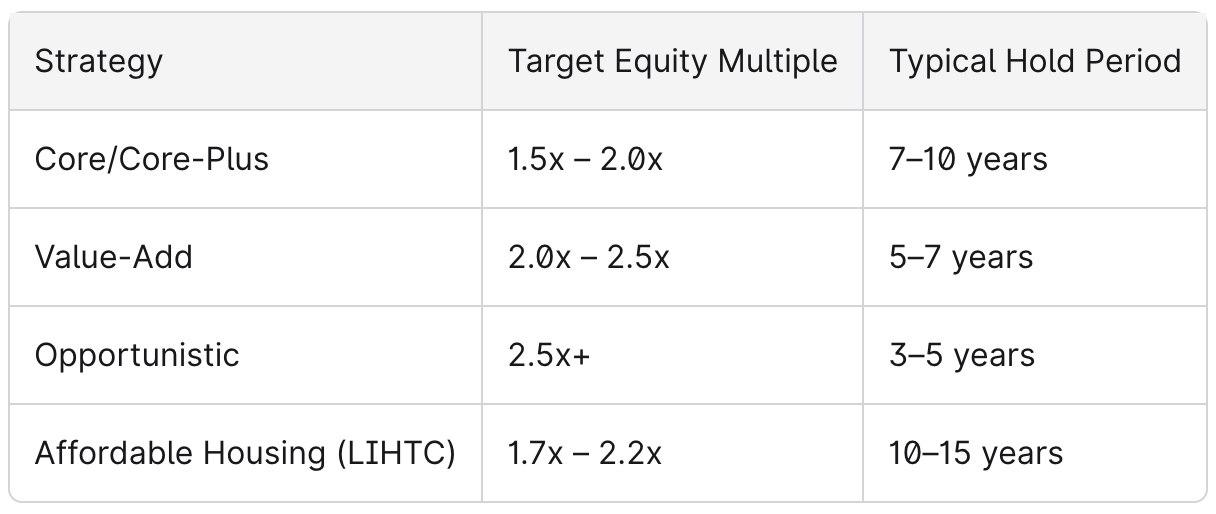
Core and core-plus stabilized multifamily with moderate leverage often targets 1.5x–2.0x over longer horizons. Value-add or opportunistic strategies—including heavy rehabilitation of distressed workforce housing—may target a higher equity multiple of 2.0x–2.5x or more due to elevated risk and shorter timelines.
Long-duration affordable housing and LIHTC investments typically seek balanced outcomes: steady cash flow combined with equity multiples in the 1.7x–2.2x range over 10–15 years. These investments prioritize stability over maximum upside.
Several few factors significantly influence achievable multiples:
Leverage: Higher debt can amplify returns but increases risk
Interest rates: Rising rates compress both cash flow and exit valuations
Cap rate movements: Exit cap rates determine sale proceeds
Market conditions: Supply-demand dynamics in specific metros
A conservative capital structure usually reduces upside multiples but improves downside protection—a tradeoff that matters deeply when investing other people’s money.
Granite Park Capital frames good equity multiples in the context of stable, government-supported rent streams, mission-driven impact, and risk-adjusted performance rather than chasing the highest possible headline number. For our investors, a slightly lower equity multiple with substantially less cash volatility often represents the superior risk-reward proposition.
How Financing and Capital Expenditures Affect Equity Multiple
Debt structure and reinvestment decisions materially change both the numerator and denominator in the equity multiple formula. Understanding these dynamics helps investors evaluate projections more critically.
Leverage Effects:
Using prudent leverage can increase equity multiple by reducing the equity required upfront while still allowing investors to participate fully in net sale proceeds after debt repayment. With less total equity invested as the denominator, the same total distributions yield a higher multiple.
However, more leverage means higher risk. Interest rate changes, refinancing risk, and the possibility of less cash flow during operations all accompany increased debt.
Capital Expenditure Impact:
Major capital expenditures—say, a $3,000,000 renovation program to upgrade an aging LIHTC property—increase total equity investment. These costs must be included in the denominator when calculating equity multiple.
Example with Capital Calls:

Despite the second investment increasing total cash invested, the renovations enabled higher rents and a stronger exit valuation, ultimately boosting total distributions and the final equity multiple.
In affordable and workforce housing, upgrades tied to energy efficiency, life-safety improvements, and regulatory compliance can be accretive to long-term equity multiple—especially when supported by state and federal incentives or when they enable properties to command higher rents within program guidelines.
Granite Park Capital’s vertically integrated platform—handling acquisitions, construction management, and property management under one umbrella—is designed to control these variables. By managing operating expenses, occupancy, and capital projects directly, we work to protect and enhance investors’ equity multiples throughout the hold.

Using Equity Multiple at the Fund Level
Equity multiple applies not only to individual properties but also to diversified funds like Affordable Housing Fund I, LP. Understanding fund-level application helps investors evaluate manager performance across entire portfolios.
Fund-Level Calculation:
A fund-level equity multiple aggregates:
All capital contributions across all deals (denominator)
All distributions back to limited partners, including income, refinancings, and realizations from asset sales (numerator)
For a closed-end fund launched in 2024 with a 10–12 year life, the calculation tracks:
Interim distributions during the hold period
Capital returned from individual asset sales
Final distributions at fund liquidation
These total distributions are measured against total LP commitments to compute the overall fund equity multiple.
Preferred Returns and Waterfall Structures:
Many private equity real estate funds, including affordable housing vehicles, incorporate preferred returns. For example, an 8% annual preferred return to limited partners means that investors receive this threshold return before any promote or carried interest flows to the general partner.
Preferred returns don’t change the equity multiple calculation itself—total distributions still divide by total invested equity. However, the preferred structure influences how and when investors receive their share of cash flows versus the sponsor.
Portfolio Diversification Context:
Investors should compare fund-level equity multiple alongside:
Portfolio diversification across property types and vintages
Geographic spread (for example, 16 states in Granite Park Capital’s portfolio)
Sector focus and strategy alignment
Leverage profile and capital structure
A 2.0x fund-level equity multiple means something different for a concentrated three-property fund versus a diversified portfolio of 70+ properties across multiple markets.
Granite Park Capital reports realized and projected equity multiples by fund vintage, allowing family offices and wealth managers to benchmark performance over time and across different market cycles.
Strengths and Limitations of Equity Multiple
Equity multiple remains popular because of its clarity and ease of communication. However, sophisticated investors recognize its important blind spots.
Key Strengths:
Easy to calculate with basic arithmetic
Intuitive for investors: “how many dollars back for each dollar in”
Useful for comparing deals with the same holding period and similar strategies
Captures total return including both income and appreciation components
Works at property, deal, and fund levels
Main Limitations:
Ignores time value of money—a 2.0x over 5 years vastly outperforms 2.0x over 15 years
Does not show annualized performance or account for opportunity costs
Can overstate attractiveness for very long-dated projects with back-loaded distributions
Identical multiples can mask dramatically different risk profiles
A levered equity multiple appears more attractive but carries higher risk than an unlevered one
Equity multiple also does not explicitly capture risk factors such as:
Leverage levels and refinancing exposure
Market volatility in specific metros
Policy changes affecting LIHTC or Section 8 programs
Concentration in any single asset or geography
For these reasons, investors should always pair equity multiple with other metrics like IRR, cash on cash return, and qualitative risk assessment. This combination provides a more complete picture of both returns and risks.
Granite Park Capital uses equity multiple as one of several underwriting checks in our $1.6B+ portfolio of 70+ properties. It informs decisions but never drives them in isolation. The metric works best alongside net present value analysis, scenario testing, and thorough due diligence on each acquisition.
How Granite Park Capital Thinks About Equity Multiples
As a fourth-generation family office focused exclusively on affordable and workforce housing, Granite Park Capital approaches equity multiple with a distinct philosophy that differs from generic commercial real estate operators.
Stability Over Speculation:
We focus on producing attractive, repeatable equity multiples primarily through stable cash flow from government-backed rent streams—HUD, Section 8, and LIHTC programs—rather than speculative appreciation alone. This approach means our projected multiples may appear more conservative than opportunistic strategies, but they carry meaningfully less downside volatility.
Vertical Integration Advantages:
Our integration across acquisition, development, asset management, and property management helps the firm manage operating expenses and occupancy rates. When we control construction timelines, maintenance quality, and resident relations directly, we can better protect projected equity multiples from the operational surprises that derail many real estate investments.
Rigorous Underwriting:
Across 13,500+ units in 16 states, we evaluate each acquisition against target equity multiple ranges under base, downside, and upside scenarios. This stress-testing helps ensure that even pessimistic assumptions yield acceptable returns for our investors.
Metrics in Context:
For accredited investors, family offices, and wealth managers, we present equity multiple alongside IRR and distribution yield. Different investors have different priorities—some emphasize current income, others prioritize total wealth creation, and many care deeply about social impact. We construct portfolios aligned with specific income and impact objectives.
Transparency in Reporting:
We report both realized and projected equity multiples clearly in our investor communications. Investors can compare fund-level performance across vintages and see how our track record aligns with forward-looking projections.
Interested accredited investors can review historical equity multiple performance and forward-looking targets by requesting the latest fund materials or attending a Granite Park Capital investor event.

Frequently Asked Questions (FAQ)
The following FAQs address practical issues not fully covered above, aimed at accredited and institutional investors evaluating affordable housing opportunities.
How long does it typically take to achieve a 2.0x equity multiple in affordable and workforce housing?
In many stabilized affordable housing strategies, a 2.0x outcome might be underwritten over 10–15 years, depending on leverage levels, rent growth assumptions within program guidelines, and exit cap rate projections. Shorter timelines typically require either higher leverage (with corresponding higher risk) or significant value-add execution. Government-backed rent stability often means steadier but more gradual wealth accumulation.
Can two funds with the same equity multiple be very different investments?
Absolutely. Two funds showing identical 2.0x equity multiples can have vastly different IRRs, risk profiles, leverage levels, and distribution patterns. One might deliver consistent annual income while another pays nothing until a back-end exit. Due diligence must examine cash flow timing, debt structure, geographic concentration, and manager track record—not just the headline multiple.
How do tax credits like LIHTC factor into equity multiple?
LIHTC benefits enhance overall investment economics by reducing the after-tax cost of capital and improving project feasibility for developers. However, the standard equity multiple calculation focuses on cash distributions rather than investor-level tax benefits. Some sophisticated models may incorporate after-tax returns separately, but the equity multiple you see in most offering documents represents pre-tax cash flows. Investors should review tax implications with qualified advisors.
Should I focus more on equity multiple or on current income if I’m a retiree?
Retirees often prioritize steady cash on cash income for living expenses, while still valuing an attractive equity multiple for overall wealth preservation. Balanced affordable housing funds can deliver both—consistent distributions from government-supported rents plus meaningful total returns at exit. The right balance depends on individual circumstances, liquidity needs, and portfolio composition. We recommend consulting a financial professional for personalized guidance.
How can I evaluate whether a projected equity multiple from a manager is realistic?
Start by stress-testing key assumptions: What happens if rent growth is 1% lower annually? What if exit cap rates expand by 50 basis points? What if vacancy runs higher than projected? Compare the manager’s projections to their realized track record on prior funds. Review downside scenarios in offering documents. A realistic projection should show sensitivity analysis and acknowledge the range of potential outcomes, not just a single optimistic figure.

